Recording a podcast with a remote guest is a solved problem. Tools that capture each participant's audio locally and upload separate tracks do that job well, and if that's your whole pipeline, you're fine.
The unsolved part comes after the call ends: the editing, which almost always funnels through one person.
The post-call bottleneck
A typical two-host show with a guest produces three tracks and a familiar routine. One host downloads everything, pulls it into a DAW, cuts the tangents, tightens the pauses, fixes levels, and exports a draft. The other host listens, sends timestamped notes - "cut the bit at 23:40", "my mic sounds boomy after the break" - and the editor makes another pass. Two or three rounds later the episode ships, late.
The notes are the tell. Timestamped comments are a description of edits, sent to the one person who can perform them. Every publishing delay in this workflow is the queue in front of that person.
Editing as a shared session
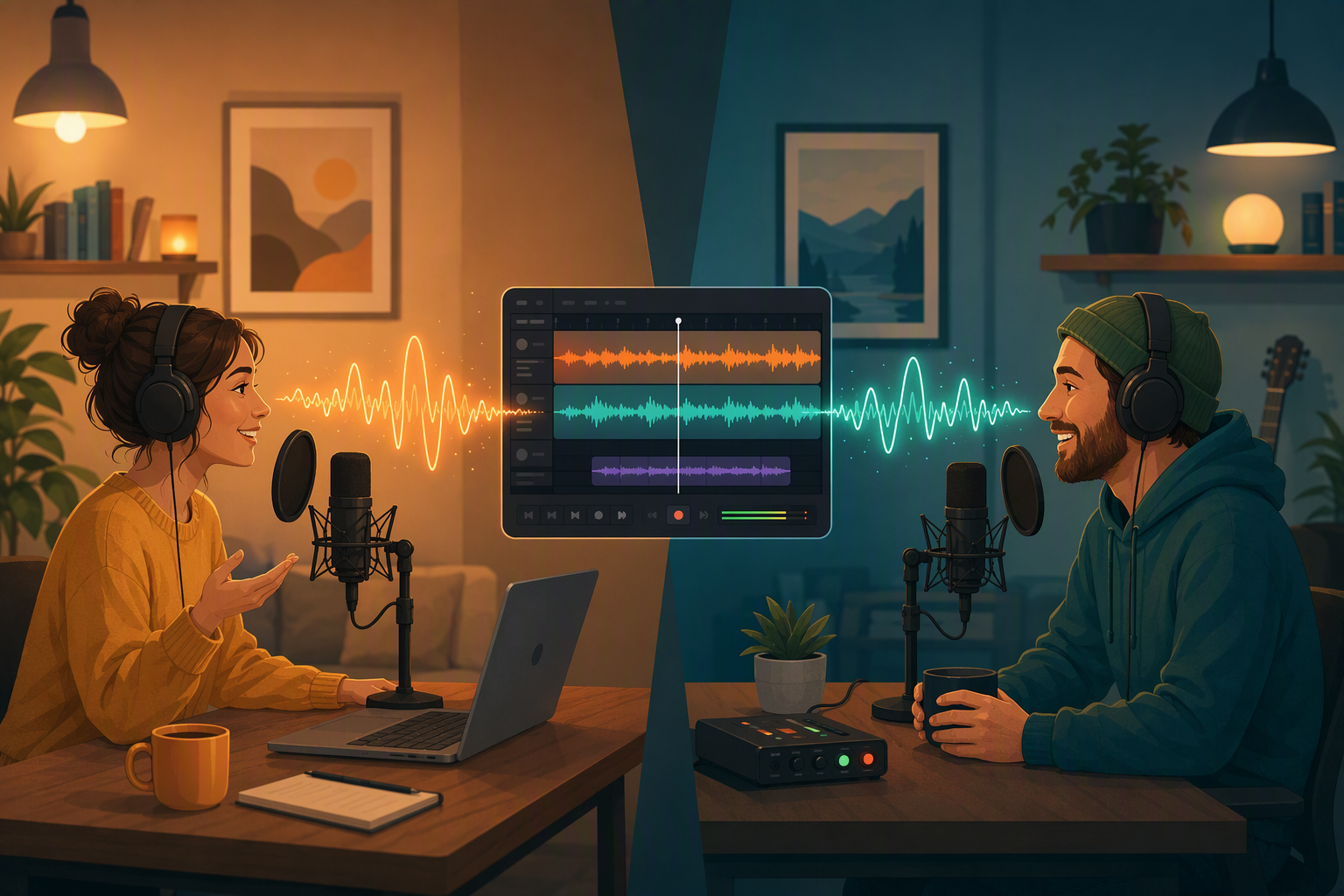
Joint is a multitrack audio workstation that runs in the browser, where several people can edit the same project at the same time. For podcast post-production, that changes the shape of the work:
- Both hosts open the same session. The episode is one project with a track per speaker - not a file that gets passed around. Whoever spots a problem fixes it instead of describing it.
- Split the pass, run it in parallel. One host cleans the first half while the other cleans the second; or one does cuts while the other rides levels and EQ. Same project, same time - you watch each other's edits appear.
- Review happens inside the project. Instead of a bounced draft and a notes document, you listen together, jump to the rough spots, and settle "keep it or cut it" while both of you are looking at the same waveform.
- The guest's fix doesn't need a round trip. If the guest needs to re-record a garbled sentence, they open the link in a browser and record straight into their track at the right spot. No file emailed back, no manual alignment.
None of this makes editorial judgment easier - deciding what to cut is still the job. It removes the queue: the show stops waiting on one editor's evenings.
Where this fits in your stack
- If you already capture calls with a local-recording tool, keep it. Drop the tracks into a shared Joint project for the edit - the collaboration gain is in post, not capture.
- For planned segments that aren't live conversation - intros, ads, narration - recording directly into the shared project skips the file handling entirely.
- Music-heavy shows get the biggest win: mixing a theme, ducking beds under speech, and balancing voices is real DAW work, and it's the part least served by podcast-specific editors.
The free tier of Joint covers a collaborative project - enough to run one episode through a shared edit and see whether the bottleneck actually disappears for your show.