Most bands don't break up over creative differences. They stall out over logistics: someone moves cities, rehearsal slots stop lining up, and the half-finished demo sits in a chat group forever.
I play in a band where exactly this happened, so this post is about the mechanics of finishing a song when you can't put four people in one room.
Why "everyone records at home and sends stems" stalls
The standard advice is stem-swapping: the drummer records to a click, exports, sends the file; the bassist imports it, plays along, exports, sends; and so on up the stack.
It can work. Here's where it actually breaks:
- Every pass adds days. Each member has to find an evening, set up, record, export, and upload before the next person can even start. A three-instrument pass takes a week if everyone is disciplined. Nobody is disciplined.
- You react to a frozen mix. The guitarist plays against a bounce of drums and bass. If the bass line changes later, the guitar part was written against something that no longer exists.
- Versioning is a chat scroll.
song_v3_drums_new.wavorsong_v3_new_drums_FIXED.wav? The project's true state lives in someone's DAW, and everyone else sees exports of it. - One person becomes the studio. Whoever owns the project file does the importing, aligning, and mixing. That person burns out first.
What changes with one shared project
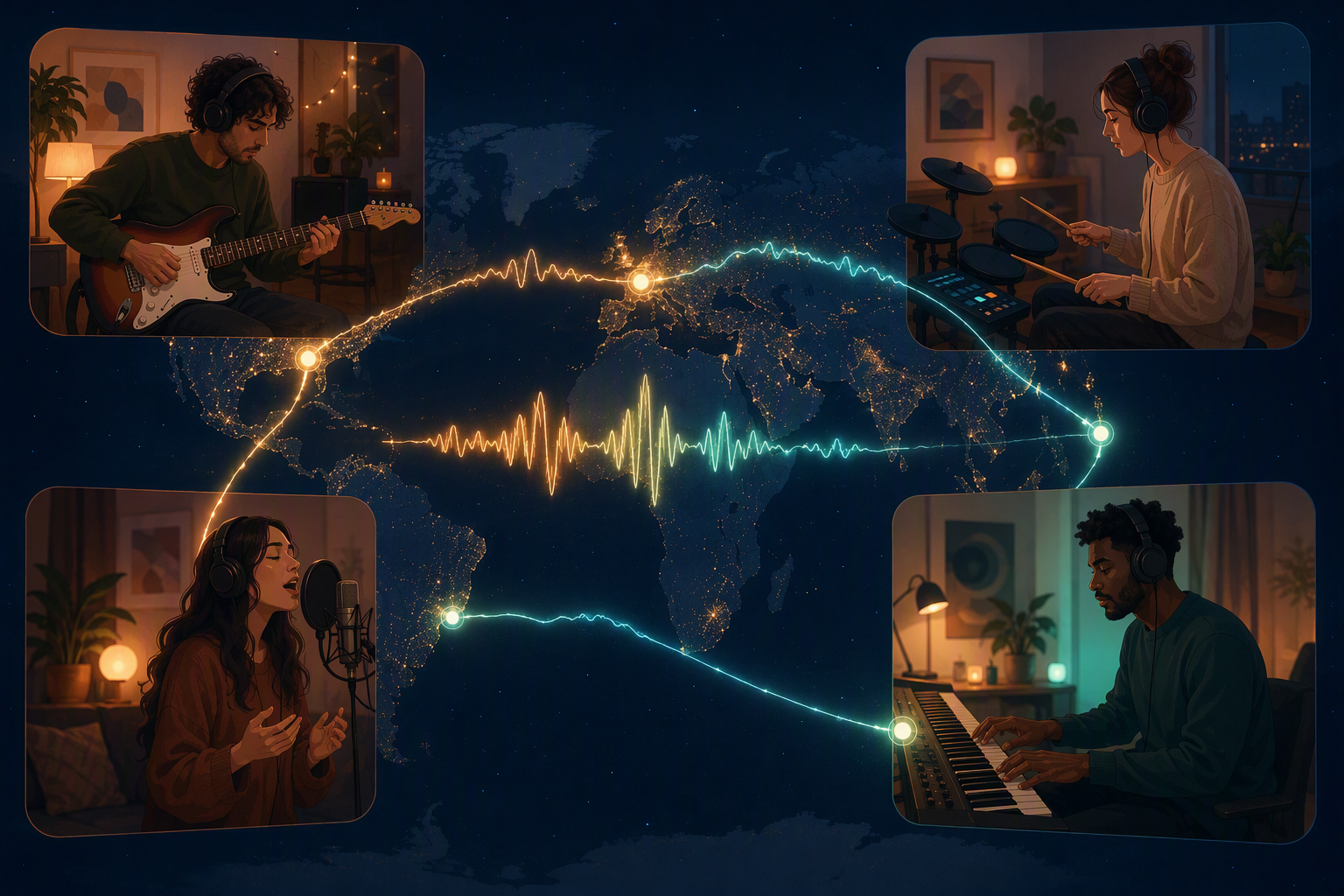
Joint is a DAW in the browser where the whole band works in the same project - the model you know from Google Docs or Figma, applied to multitrack audio.
The workflow difference is bigger than it sounds:
- Parts are recorded, not delivered. You open the project link and record into your track. There is no export step, so there is nothing to collect, rename, or re-align. When you stop recording, the band already has your take.
- You hear the current song, not last week's bounce. When the bassist rewrites the bridge on Tuesday, the guitarist hears the new bridge on Wednesday - in the project, under their own part.
- Editing and mixing are shared work. Comping takes, tightening timing, balancing levels - anyone with the link can do their share, at the same time, and everyone sees the same state. There is no "who has the latest session file" because there is only one session.
- Disagreements resolve by listening, not by describing. "Turn the guitars down" becomes: drag the fader, both of you listen, decide. The feedback loop drops from days to seconds.
A realistic remote session looks like this: you book an hour on a video call, everyone opens the same project, the drummer's new take lands while the singer mutes and unmutes harmony options, and you leave the call with a rough mix instead of a to-do list.
Practical notes
- Agree on the click first. Tempo changes after parts are recorded are painful in any workflow, shared or not.
- Record more takes than you think you need. Storage is cheap; a re-record session across time zones is not.
- Keep a voice channel open while tracking together. The project carries the audio; you still want to talk between takes. Any call app works.
- Latency reality check: real-time collaboration means everyone edits the same live project. Jamming in perfect sync over the internet is a physics problem no browser can fix - so track to the click, not to each other's live signal.
If your band has a stalled demo, open a free project, drop the existing stems in, and send the link to the group chat. The novelty of hearing the song update in front of everyone tends to un-stall things.